Cornelius, NC · Water damage response
Hardwood Floor Water Damage in Cornelius, NC
Raised edges, dark seams or water beneath a wood floor need a material-specific assessment. The drying technician checks the boards and backing, evaluates controlled drying options and documents whether the floor can remain after the water source stops.
(888) 578-4720Measure beneath the wood surface- 24/7 wet-floor assessment
- Board and subfloor readings
- Salvage based on material condition
First steps
First steps for hardwood floor water damage
- Stop safe foot trafficBuckled or loose boards can create a trip hazard. Occupants should avoid forcing a raised section flat or placing heavy furniture on it before the assembly is assessed.
- Remove only accessible surface waterPeople should avoid powered household equipment near standing water. The extraction crew uses an appropriate tool while checking whether contamination or damaged wiring changes the safe approach.
- Leave sanding for the repair stageSanding a still-wet floor can create a poor result as board dimensions continue changing. Material readings and the flooring professional’s assessment should precede finish correction.
- Identify the floor productA spare board, installation record or product label can help distinguish solid wood, engineered wood and a composite surface. Each construction can respond differently to water exposure.
Planning costs
What does hardwood floor water damage cost in Cornelius, NC?
Hardwood floor water damage mitigation often ranges from $1,500 to $7,500. The floor product, wet backing, affected area and potential for controlled drying set the work. Sanding, refinishing and replacement need their own scope after assessment.
Localized wet boards
$1,500 to $3,000- Material identification and moisture mapping
- Targeted extraction or drying equipment
- Checks of adjoining unaffected reference areas
Backing and wider floor area
$3,000 to $5,000- Monitoring through connected floor layers
- Specialty drying where the assembly allows
- Selective access to trapped moisture
Damaged or contaminated assembly
$5,000 to $7,500+- Removal of unsuitable flooring sections
- Drying and assessment of retained subfloor
- Clear separation from replacement finishes
Estimate only. The water damage cost calculator shows how wet area, contamination and material choices affect the planning range.
Measured work
The hardwood floor water damage process
Identify the assembly
The technician checks the wood product, installation method and backing. The same surface appearance can cover very different moisture paths underneath.
Map the gradient
Readings at affected and suitable reference areas show where moisture remains. Board movement and physical damage are recorded alongside the measurements.
Apply controlled drying
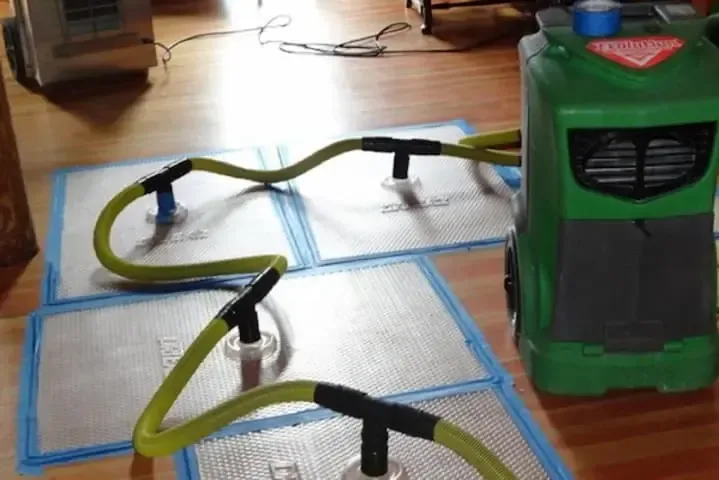
Where retention is appropriate, the team uses suitable extraction mats, airflow and dehumidification. Equipment adjustments follow material response rather than appearance alone.
Evaluate the final condition
The flooring professional reviews stability and repair options after drying. The documentation distinguishes a moisture goal from a promise that damaged boards regain their original shape.
A wood floor can feel dry while its underside remains wet. Uneven moisture through a board can change its shape, and a backing layer can hold water against the subfloor. Hardwood floor water damage assessment looks beyond shine, color and surface touch.
The product matters more than the neighborhood
Homes near Lake Norman can contain several types of wood and wood-look flooring. A building on Catawba Avenue may have a different installation from one near Cain Center for the Arts. The technician identifies the actual material rather than assuming a floor type from the location or appearance of the room.
- Solid wood, engineered layers and composite products need different retention decisions.
- Glue, underlayment and fasteners affect how moisture moves and how the floor can be accessed.
- Dark joints may signal moisture without proving the full extent of the affected area.
- Board separation, delamination or contamination can limit salvage even after drying succeeds.
Specialty drying needs a suitable assembly
Floor mats can extract moisture from some wood assemblies, but they are not a universal solution. The drying team evaluates contact, surface condition and the moisture path. The crew also checks wall bases and adjoining rooms so equipment does not address one floor section while another layer remains wet.
Heavy weights, uncontrolled heat and early sanding can change the floor before its moisture condition stabilizes. Occupants should keep clear of raised edges and leave alteration to the flooring professional. The restoration technician first records the board and backing condition, assesses contamination and selects an appropriate drying approach. A visibly flatter surface does not by itself prove that moisture beneath the assembly has reached an acceptable level.
Use records to choose repair, not to promise salvage
The final measurements and physical-condition notes support an informed replacement or refinishing decision. EPA water information provides general water context; Ready.gov flood information explains precautions after water enters buildings. The particular floor product and installer requirements still govern the repair handoff.
Coverage
Hardwood floor water damage in Cornelius
The restoration team serves ZIP 28031, including the Catawba Avenue corridor and homes near Lake Norman. Crews check the actual source and wet materials at each property. Coverage also includes Mint Hill, Pineville, Westport, Sherrills Ford and Stanley.
Related services
Related water damage services in Cornelius
Questions
Hardwood Floor Water Damage questions in Cornelius
(888) 578-4720Discuss the board movement and moisture01Can every cupped floor be saved?
No. Material construction, physical damage, contamination and the moisture response determine the options. Controlled drying may help a suitable floor, but it cannot promise that delaminated or permanently damaged boards regain their original condition.
02Why measure the subfloor too?
The backing can retain moisture after the board face dries. That moisture may continue affecting the floor or adjoining walls. The technician checks connected layers before deciding that the drying work is complete.
03Are drying mats always appropriate?
The assembly and surface condition determine suitability. A technician evaluates whether a mat system can reach the moisture effectively and safely. Some products or contaminated layers require access or removal instead.
04When can sanding begin?
The flooring professional should review material stability after drying verification. Sanding while dimensions are still changing can create an uneven result. The repair decision needs both moisture records and a physical-condition assessment.
05Can wet flooring receive an urgent inspection?
24/7 dispatch supports water damage assessment. The team needs the source status, visible board movement and any access hazards. Prompt source control and extraction can limit further spread without a promise of salvage.
06Is replacement part of the drying price?
Floor replacement, refinishing and damage mitigation are separate work items. A clear scope identifies which tasks remove water, which address retained backing and which restore the finished walking surface.
24/7 water damage response
Make the flooring decision after material testing
The drying technician records the board, backing and subfloor condition so the repair professional can assess the next step.